
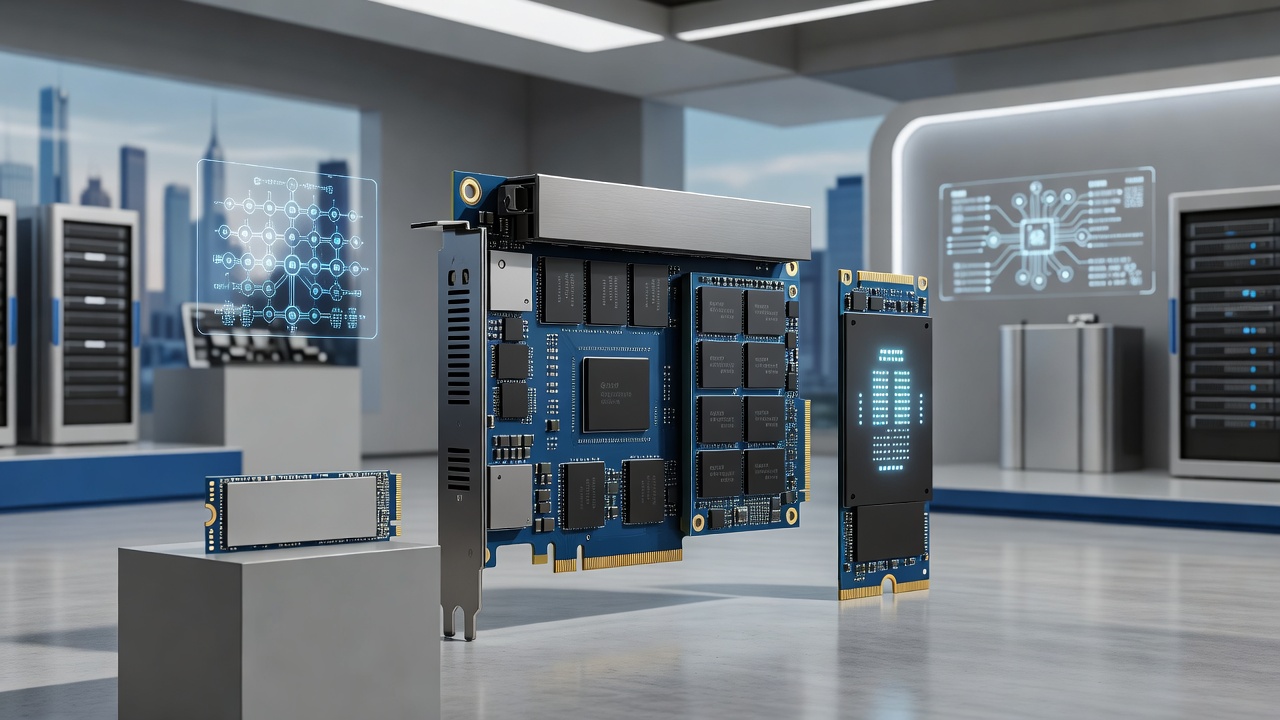
At Supercomputing 2026 in Chicago, Silicon Motion is demonstrating new PCIe Gen5 and Gen6 enterprise SSD controllers built to handle the storage demands of AI factories and agentic AI systems. The company's booth presentation spans both high-capacity data storage for inference workloads and lower-profile boot drives meant to keep servers running reliably.
Scaling capacity for AI inference
The centerpiece of Silicon Motion's AI factory lineup is the SM8366 MonTitan, a PCIe Gen5 reference design that supports common enterprise drive formats including U.2, E1.S, E3.S, and E1.L. By pairing QLC NAND flash with this controller, the company says capacities can scale up to 256 TB per drive - a figure aimed squarely at workloads like key-value cache offload, a technique used in large language model inference to store intermediate computation results outside of more expensive and limited GPU memory. The platform also includes what Silicon Motion calls its PerformaShape QoS Engine, intended to keep latency predictable even when multiple demanding processes compete for the same storage resources.
For organizations building out next-generation inference clusters, this kind of high-capacity, QoS-managed storage can reduce the amount of data that must be re-fetched or recomputed, which matters as inference workloads grow larger and more latency-sensitive.
Faster throughput with PCIe Gen6
Moving beyond Gen5, the SM8466 controller is built for PCIe Gen6 and targets applications that need very high bandwidth. Silicon Motion specifies sequential throughput up to 28 GB/s and as many as 7 million random IOPS (input/output operations per second), with support for SSD capacities exceeding 512 TB. These are vendor-stated performance figures tied to a reference design rather than independently verified benchmarks, so real-world results will depend on system integration, NAND configuration, and workload characteristics.
Separately, the SM8388 controller addresses a different need: power-efficient nearline storage for hyperscale data centers. Its single-controller architecture is designed to balance flash capacity, power draw, and overall cost - a trade-off that matters for data centers running at scale, where energy consumption directly affects operating expenses.
Boot storage and embedded systems
Beyond primary AI storage, Silicon Motion is also showing boot-drive solutions meant to keep servers, DPUs (data processing units), and networking equipment running. These include DRAM-less PCIe NVMe SSDs in compact M.2 and BGA packages, aimed at systems where space and power efficiency are priorities.
A separate DRAM-equipped PCIe Gen5 boot SSD, available in M.2 2280 and E1.S form factors, targets workloads with frequent data access - such as system logging and metadata management - offering capacities from 480 GB to 3.84 TB and sequential read speeds up to 14 GB/s, according to the company. The lineup also includes an enterprise PCIe NVMe boot drive implementation built around Nvidia's DPU platform, along with a Ferri-eMMC embedded storage solution paired with ASPEED's AST2600 baseboard management controller, used for out-of-band server management tasks.