
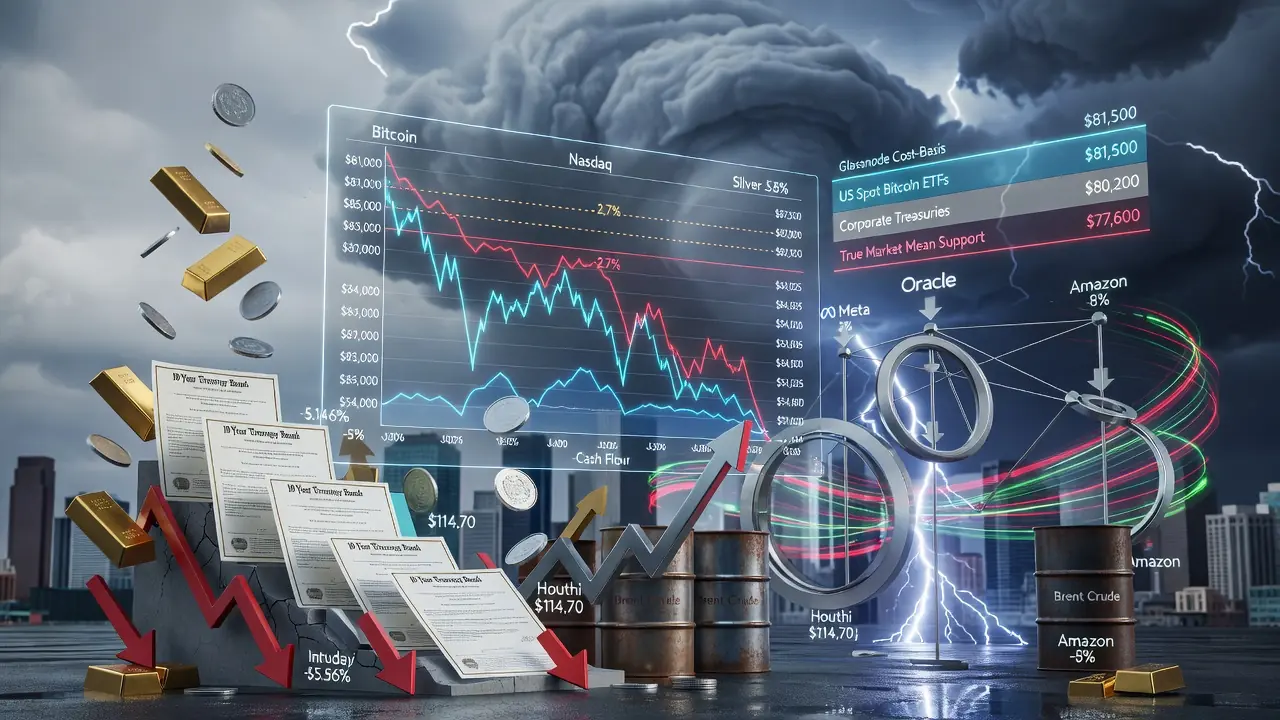
Bitcoin briefly slipped under $81,000 on Oct. 22 as a rare pattern emerged across markets: stocks, gold and silver all fell at once while government bonds rallied sharply. The 10-year Treasury yield dropped from 5.146% to below 5% in its steepest one-day decline in more than two years, even as oil spiked and corporate credit stress deepened at a handful of major tech companies.
Four Assets, One Direction
Bitcoin traded in step with the Nasdaq, which lost more than 2%, while spot gold fell about 2.7% to $4,025 and silver dropped roughly 5.8% to near $54.63. Ordinarily these assets diverge depending on risk appetite and inflation expectations. Their simultaneous decline, paired with a bond rally, suggests investors were pulling capital toward Treasuries rather than rotating between risk and safety in the usual way. The World Gold Council's Oct. 19 "Bonds back in the room" report had already flagged Treasuries rallying despite hot inflation data, raising the possibility that safe-haven demand for bonds was competing directly with gold for investor capital.
Separating that explanation from alternatives would require tracking gold ETF flows, real yields and futures positioning - data not yet available to confirm the mechanism definitively. Silver's steeper drop likely reflects its greater exposure to speculative positioning and industrial demand swings.
Credit Stress at Meta and Peers
Meta's third-quarter results added pressure to tech-sector sentiment. The company reported revenue of $64.6 billion, up 26%, but capital expenditures hit $34.9 billion and free cash flow turned negative $2.1 billion. Meta also raised the low end of its 2026 capex guidance by $5 billion, to a range of $135 billion to $145 billion, and introduced a new class of non-voting shares partly aimed at supporting financing needs. Shares fell about 8% on Oct. 22, and Meta's five-year credit default swap spread rose to a record 114.79 basis points. Oracle and Amazon showed similarly elevated spreads, though confirming a broader credit squeeze would require wider investment-grade and high-yield index data beyond these individual issuers.
Oil Shock Complicates the Fed's Calculus
Brent crude touched an intraday high of $114.70, its highest level this year, after renewed Houthi attacks in Saudi Arabia stoked supply concerns. Higher fuel costs squeeze household and corporate spending and keep inflation pressure alive - a dynamic that markets are weighing against roughly 78% odds of a December rate cut, even as the Fed is expected to hold steady at its Oct. 28 meeting.
Bitcoin's Cost-Basis Zones in Focus
Glassnode's Oct. 21 report placed the average acquisition cost for US spot Bitcoin ETFs near $81,500 and for corporate treasuries near $80,200, with fresh spot buying appearing near $80,000. A further support level, the "True Market Mean," sits near $77,600, while overhead resistance runs from $85,000 to $87,500. Upcoming data - including flash PMIs and the University of Michigan's consumer sentiment survey - will offer early signals on whether growth fears or inflation concerns are driving the bond rally. A stable Bitcoin price in the $80,000-$81,500 range would suggest the cost-basis zone is absorbing the selloff; a close below $80,000 would put average ETF holders at a loss and bring the lower $77,600 level into play.