
Hong Kong Researchers Engineer Alloys That Resist Cracking Near Absolute Zero
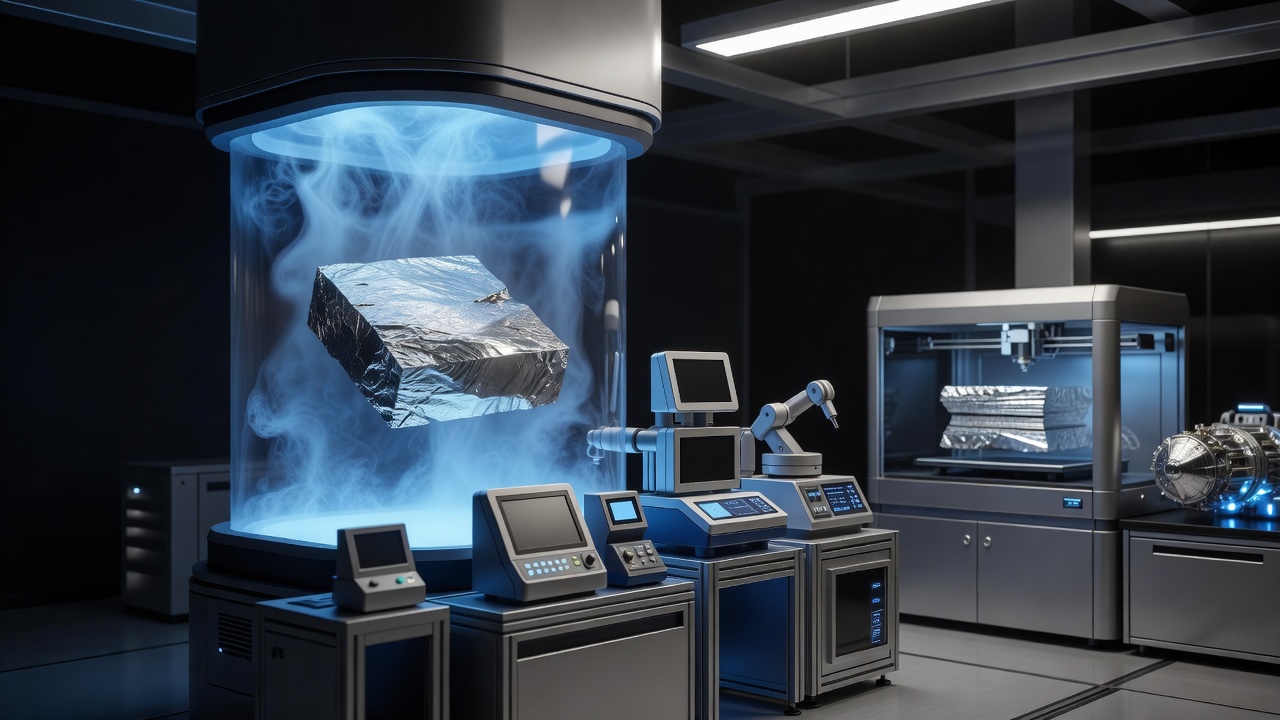
A team at The Hong Kong Polytechnic University has developed new metal alloys that keep their strength and flexibility at liquid-nitrogen temperatures, a longstanding weak point for materials destined for spacecraft, superconducting systems and deep-sea vehicles. Led by Prof. Zibin Chen, the group published two studies in Nature Communications describing distinct manufacturing approaches that both push past the usual trade-off between strength and brittleness in extreme cold.
Why cold temperatures break metal
Metals often become stronger as temperatures drop, but that added strength typically comes at the cost of ductility, the ability to bend or stretch without snapping. At very low temperatures, this "cold brittleness" can cause sudden, catastrophic failure - a phenomenon historically linked to the Titanic's hull fracture. For equipment operating in deep space or deep-ocean environments, where temperatures can approach 77 Kelvin (about −196°C), engineers have long needed alloys that avoid this failure mode without sacrificing load-bearing capacity.
A curved interface inside the metal
Prof. Chen's team addressed the problem with what it calls a "negative-curvature interface" strategy, reshaping the surface geometry of nanoscale particles embedded within an alloy. This adjustment lets tiny internal precipitates - previously just passive reinforcements - actively guide how the material deforms under stress, favoring gradual, controlled deformation over sudden cracking. Applied to a nickel-cobalt-chromium alloy with aluminum and tantalum additions (NiCoCr-AlTa), the technique produced a material with a yield strength of about 1.30 GPa, tensile strength near 1.80 GPa, 50% ductility and fracture toughness around 213 MPa·m¹ᐟ² at 77 K - a combination the researchers describe as a new benchmark for cryogenic alloys. Notably, the alloy can be produced through conventional smelting, rolling and short-term aging, which the team says simplifies the path toward industrial-scale manufacturing.
3D printing adds a second route to stronger alloys
In a related study, the team combined additive manufacturing with specialized post-processing to build a "hierarchical nano-orderings" structure into a separate NiCoCr-based alloy. This method sequentially activates internal deformation mechanisms so the material actually strengthens as it is stressed. At liquid-nitrogen temperatures, this alloy reached a yield strength near 2.0 GPa, tensile strength around 2.4 GPa and 22% uniform ductility - figures the researchers describe as record-setting for this class of material.
From lab results to real hardware
Both findings remain at the research stage. The team plans to validate industrial-scale samples of the NCI-based alloy, targeting commercial applications within roughly a decade, while the 3D-printed alloy is further along, with a five-year commercialization goal. Prof. Chen noted that the underlying interface strategy could extend to other precipitation-hardened alloy families, including superalloys, age-hardening steels and aluminum alloys, potentially offering a broadly applicable, cost-effective design approach for industries that depend on materials performing reliably in extreme cold.