
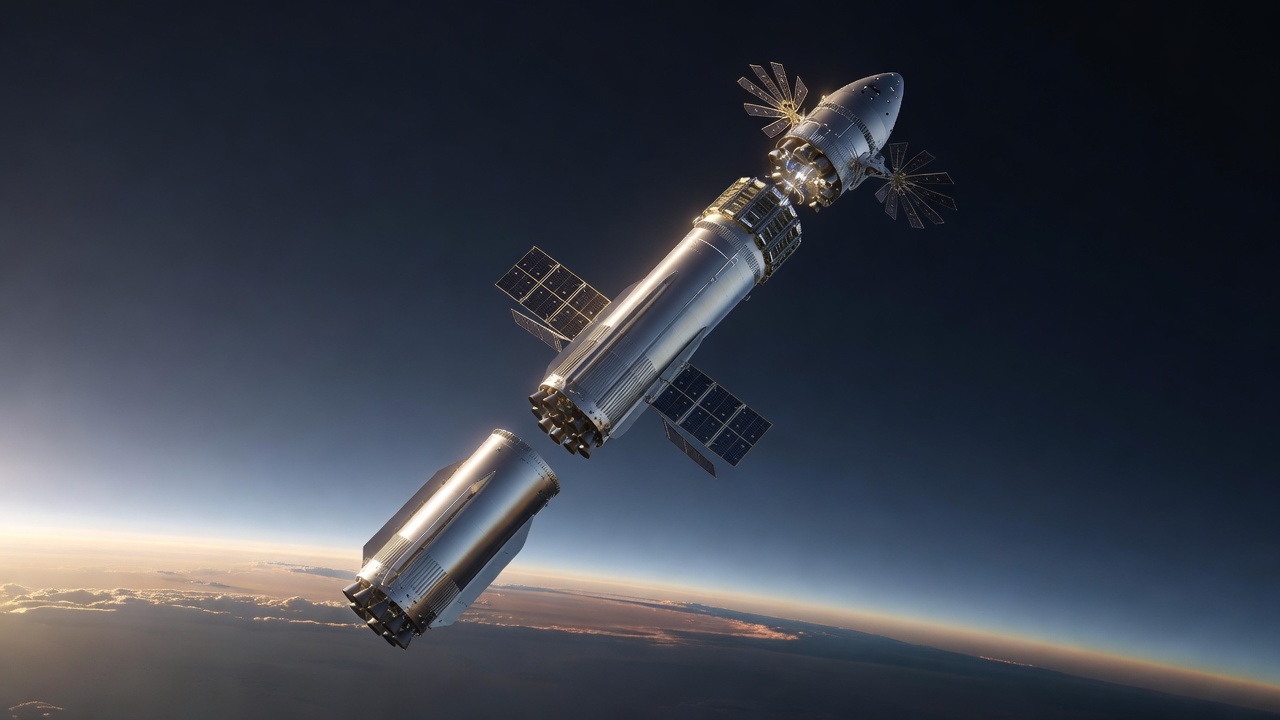
Cowboy Space Corporation, founded by Robinhood co-founder Baiju Bhatt, has revealed the design of a new launch vehicle called Big Iron whose upper stage does not discard after reaching orbit. Instead, it remains aloft permanently, functioning as a megawatt-class data center and joining a growing orbital compute constellation with each flight.
A rocket stage that stays in service
Conventional rockets jettison their upper stages once they deploy a payload. Cowboy's approach inverts that model: the second stage of Big Iron is engineered to remain in orbit indefinitely as functioning infrastructure. According to the company, once deployed in a dawn-dusk sun-synchronous orbit, the structure unfolds to roughly 132 meters by 73 meters and can host five compute racks built around NVIDIA's Vera Rubin GPUs. Because the stage itself becomes the asset rather than scrap hardware, Cowboy says every launch adds durable compute capacity instead of ending in disposal.
Dual-purpose hardware to cut cost and complexity
Cowboy says it designed Big Iron for a single mission - placing data centers in orbit - which the company argues simplifies the vehicle compared with general-purpose launch systems. Several components are described as serving two roles depending on flight phase: the rocket's stainless steel skin reportedly doubles as the data center's radiator once in orbit, the ammonia used during ascent becomes a coolant, and nitrogen that pressurizes the second stage is also used to deploy the satellite's solar wings. The stainless steel vehicle, with a reusable first-stage booster, stands 86 meters tall and is sized to fit standard road-transport limits, which the company says speeds production and lowers capital costs. Cowboy states the design targets more than 15,000 kg of payload to sun-synchronous orbit.
Propulsion choices and a commercial launch option
The first stage relies on nine engines the company calls "Clydesdale," burning liquid oxygen and methane and each rated at 300,000 pounds of thrust. Cowboy says it chose methane specifically to support reusability and opted for a gas generator engine cycle - a well-established architecture - to shorten the timeline to a first flight, rather than pursuing a more novel but riskier engine design.
Alongside the vehicle architecture, Cowboy introduced "Big Iron Express," a commercial launch service intended for outside customers seeking megawatt-class power in orbit, whether for computing workloads or other applications. The company states that opening the same upper-stage platform to other payloads is meant to improve launch economics and offer an additional path to orbit for the broader industry. Cowboy has not disclosed a scheduled first-flight date, pricing, or independent verification of the performance figures described.