
Caltech Study Finds Burning Cars and Buildings Drove Extreme Lead Spikes in Eaton Fire Smoke
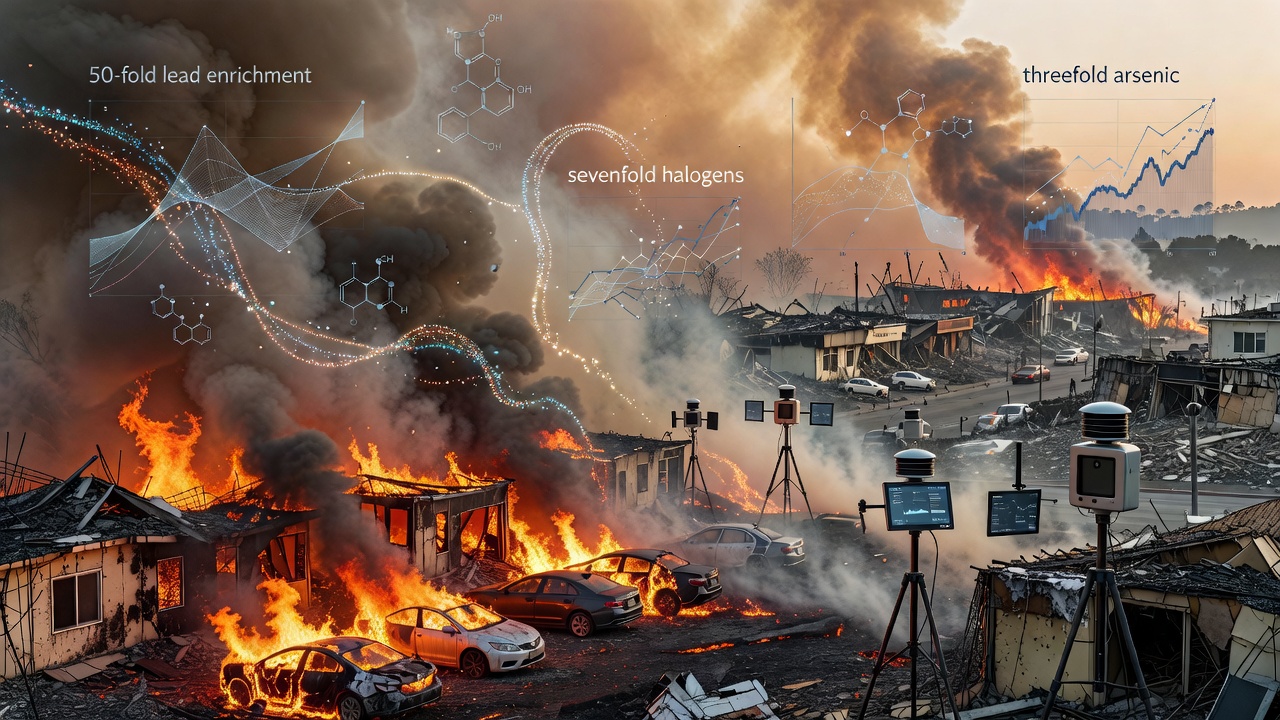
A new Caltech analysis of the January 2025 Eaton Fire found that smoke from the urban blaze carried far higher concentrations of toxic metals than typical wildfire smoke, with lead levels reaching roughly 80 times normal background amounts. Researchers say the contamination traces back to burning vehicles, electronics and building materials rather than vegetation, pointing to a distinct and understudied category of fire pollution.
How researchers measured the chemical shift
The study, led by Caltech PhD student Haroula Baliaka along with co-author Ryan Ward, relied on continuous air-monitoring data from the Atmospheric Science and Chemistry mEasurement NeTwork, known as ASCENT. The network tracks the chemical composition and particle size of airborne pollutants around the clock, allowing scientists to compare the Eaton Fire plume directly against the profile of a conventional wildland fire. Caltech professor Nga Lee "Sally" Ng, who worked on the project, said the system's ability to resolve particle chemistry in real time was central to identifying the anomaly.
According to the published findings, the urban plume was enriched more than 50-fold in lead, sevenfold in halogens and threefold in arsenic compared with typical wildfire smoke. Researchers attribute this signature to the combustion of man-made materials, a "fundamentally different fuel" source than the trees and brush that burn in conventional wildland fires.
Why an urban fire burns differently
Wildfires that spread through dense neighborhoods consume a mix of synthetic and industrial materials, including automotive parts, electronic devices, plastics, paints and construction components. Many of these materials contain heavy metals and halogenated compounds that are released or vaporized at high combustion temperatures. The Eaton Fire ignited on January 7, 2025, alongside the Palisades Fire; together the two fires killed at least 31 people and destroyed more than 16,000 structures, forcing widespread evacuations and leveling much of the business district in Pacific Palisades.
The study's authors argue that because this type of smoke differs chemically from the wildfire emissions that have driven decades of air-quality research, existing exposure guidelines may not adequately capture the risks. They call for revised monitoring and emergency-response frameworks as fires increasingly spread into populated urban areas.
Health implications and open questions
Lead exposure is associated with developmental harm in children and can damage the kidneys and nervous system in people of any age at sufficiently high levels. The Caltech findings document elevated concentrations in the air during the fire but do not by themselves establish the specific health outcomes experienced by residents who were exposed. Researchers say further work is needed to translate these atmospheric measurements into clearer public-health guidance, including how long such contamination lingers in soil, dust and indoor environments after a fire is extinguished.